DiagramDB, drawDB, or DB Fiddle? Choose an ERD Tool, Schema Canvas, or SQL Playground
DiagramDB, drawDB, and DB Fiddle all make database work lighter in a browser, but they begin at different points: a quick private ER diagram, a visual schema workspace, or a runnable SQL notebook.
DiagramDB, drawDB, or DB Fiddle?
When a database idea is still moving, the best tool is usually the one that matches the next decision—not the one with the longest feature list. DiagramDB, drawDB, and DB Fiddle all keep work in a browser, yet they answer three different questions: How should this schema look? How should its tables fit together? Or what will this SQL actually do?
Start with DiagramDB for a lightweight private sketch
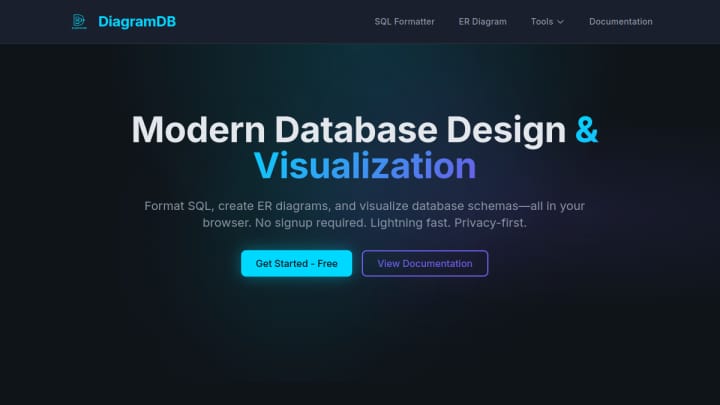
DiagramDB is the most direct fit when you need to move between SQL cleanup and a quick visual model without opening a full project workspace. Its browser tools format, validate, and minify SQL, then turn SQL DDL or text definitions into ER diagrams and schema views. The core workflow is free and does not require an account; according to its public documentation, work is processed in the browser and saved locally.
That combination is useful for a short design review, checking a pasted query, or making a diagram you can export and hand off. It is not the tool to choose when a shared cloud workspace or application backend is the primary need.
Choose drawDB when the schema canvas is the work
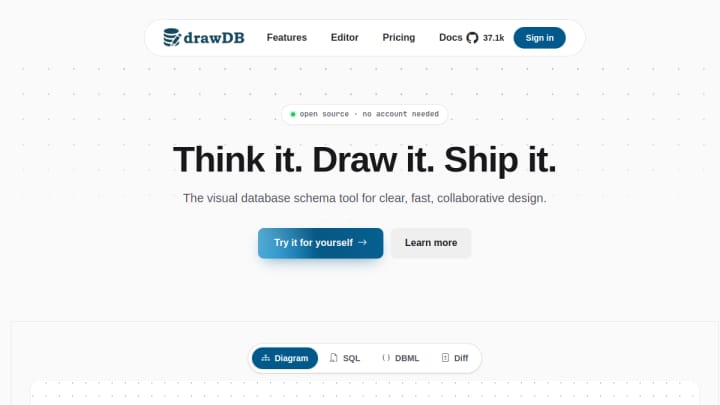
drawDB is closer to a dedicated visual schema editor. Draw tables and relationships on its canvas, then generate SQL or DBML for supported database dialects. Its open-source browser editor can be used without an account, while optional Pro features add cloud sync, collaboration, and AI-related capabilities.
Pick drawDB when the diagram itself needs more attention—for example, when you are mapping several entities, revising relationships with teammates, or want a visual source of truth before implementation. The free local editor is a good low-friction starting point, but the broader collaboration workflow belongs to its optional cloud layer.
Use DB Fiddle when the SQL needs to run
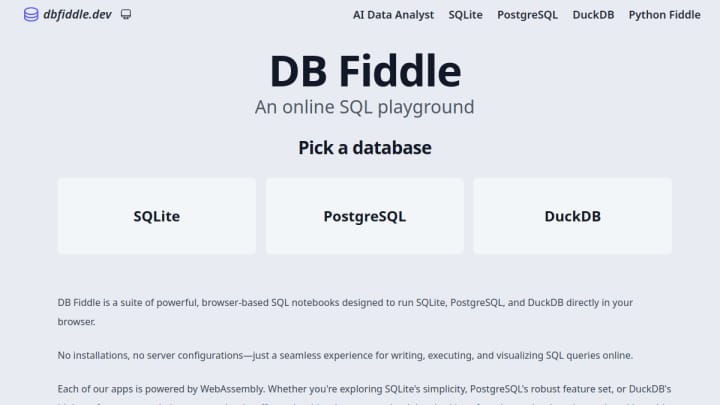
DB Fiddle focuses on execution rather than diagramming. It provides browser notebooks for SQLite, PostgreSQL, and DuckDB, so you can write schema and query cells, run them, and inspect results without configuring a database server.
It is the clearer choice for testing a query, sharing a minimal reproducible example, or comparing behavior across supported engines. Whimera currently lists its price and registration requirements as unknown, so verify those details on the product site if they matter for your workflow.
A practical way to choose
- Choose DiagramDB for a free, no-sign-up browser tool that combines quick SQL utilities with simple ER diagrams and local-first handling.
- Choose drawDB when drawing and refining a richer schema canvas is the main task, especially if its optional cloud collaboration is relevant.
- Choose DB Fiddle when you need a working SQL experiment rather than a diagram.
These tools can also form a compact sequence: sketch relationships in DiagramDB or drawDB, then validate the critical query in DB Fiddle. The useful boundary is not which tool is bigger; it is whether your next step is modeling, communicating, or executing.