CyberChef guide: turn one-off data fixes into repeatable recipes
Learn how CyberChef recipes work, which encoding and data tasks they suit, how to verify results, and where local processing has limits.
CyberChef is often described as a “Cyber Swiss Army Knife,” but the metaphor can hide its most useful idea: operations are not isolated buttons. You arrange them into a recipe, watch data pass through each step, and keep the process for the next time the same problem appears.
That makes CyberChef valuable far beyond security work. Developers, analysts, support teams, students, and data-minded users can use it for encoding, compression, hashes, timestamp conversion, character sets, parsing, and quick format investigation without assembling a new script for every question.
The four-part mental model
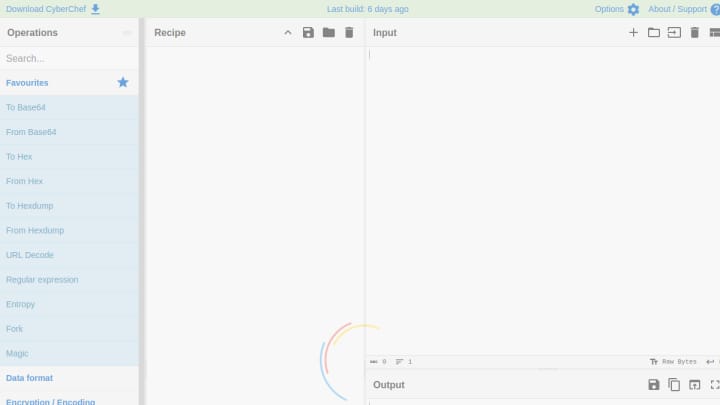
The official CyberChef repository describes four main areas:
- Input holds pasted text or a loaded file.
- Operations is the searchable catalog of transformations.
- Recipe is the ordered list of operations and their arguments.
- Output shows the result of baking the current input through the recipe.
Once this clicks, the interface stops looking like an enormous menu. You search for a transformation, drag it into the recipe, configure it, and inspect the result. Add another operation only when the next step is clear.
A simple recipe: decode, decompress, inspect
Imagine receiving text that was Base64-encoded after compression. A manual workflow might involve a decoder, a temporary file, a command-line decompressor, and another viewer. In CyberChef, the recipe can express the chain directly:
- Add the appropriate Base64 decoding operation.
- Inspect the intermediate output to confirm that the first step produced plausible binary data.
- Add the matching decompression operation.
- Decode the resulting bytes as text only if the output actually represents text.
- Save or share the recipe after removing sensitive input.
The specific operations depend on the data. Do not add transformations until the output “looks right”; confirm headers, expected lengths, checksums, or a known sample when possible.
Auto Bake, breakpoints, and Magic
CyberChef normally recalculates output as the input or recipe changes. The project calls this Auto Bake. It is convenient for small inputs but can be disabled when a recipe or file is expensive to process.
Breakpoints pause execution before an operation, which makes them useful for understanding a long chain. Step through and ask whether each intermediate representation is what the next operation expects.
The Magic feature tries to recognize likely encodings and can suggest a path through nested transformations. Treat suggestions as hypotheses. Automated detection is a starting point, not proof that an interpretation is correct.
Tasks CyberChef handles especially well
Encoding and decoding
Base64, hexadecimal, URL encoding, character sets, and similar transformations are ideal recipe steps because the output is easy to compare with expected data. Remember that encoding is not encryption; it changes representation rather than providing confidentiality.
Hashes and checksums
Generate a digest to compare files or verify a documented checksum. A hash match can support integrity verification, but a random hash value by itself does not prove that a file is safe.
Timestamp and text conversion
CyberChef can help interpret timestamps, line endings, Unicode escapes, and unusual byte representations. These operations are useful in logs, APIs, migrations, and incident notes where small representation differences create confusing bugs.
File and protocol inspection
Hexdumps, decompression, certificate parsing, and binary operations help reveal what a file contains. Use small, trusted samples first; very large inputs and expensive operations can consume substantial memory in the browser.
Repeatable analyst workflows
A recipe is easier to review than a list of remembered clicks. Share the operation chain with a colleague, keep a sanitized deep link, or download a local copy of CyberChef for an approved environment.
Client-side processing and its boundary
CyberChef’s repository says recipe configuration and input are processed entirely client-side and are not sent to the CyberChef web server. It also documents a downloadable build that can run locally or inside a closed network.
That is a meaningful architectural claim, but it should not become “paste every secret into the public site.” Consider:
- whether browser extensions can access page content;
- whether the current site and its dependencies are the expected build;
- whether a recipe URL includes input data;
- whether clipboard history, screenshots, downloads, or logs create another copy;
- whether organizational policy requires a reviewed offline deployment.
For credentials, private keys, customer records, or incident evidence, synthetic input or an approved local instance is the safer default.
How to verify a recipe
A transformation is trustworthy when you can test it, not when the output merely appears readable.
- Start with a known input and known output.
- Check each intermediate stage with breakpoints.
- Use explicit character encodings and formats.
- Confirm byte length, headers, or checksums where available.
- Reverse the recipe when the operations are reversible.
- Keep sensitive input out of shared URLs and screenshots.
- Record what the recipe assumes, especially keys, initialization vectors, compression formats, and time zones.
CyberChef or another tool?
Choose JSON Crack when you already have structured data and need to understand its graph, schema, or nesting. Choose IT-Tools when a small everyday converter is faster than constructing a recipe. Choose Mermaid Live Editor when the output you need is a maintainable diagram.
CyberChef wins when multiple operations form a pipeline or when inspecting the intermediate states is part of solving the problem. See more options in our best browser tools for developers.
The CyberChef listing on Whimera records its catalog facts and evidence source. Check the official repository for the latest release behavior before using it in a high-stakes workflow.